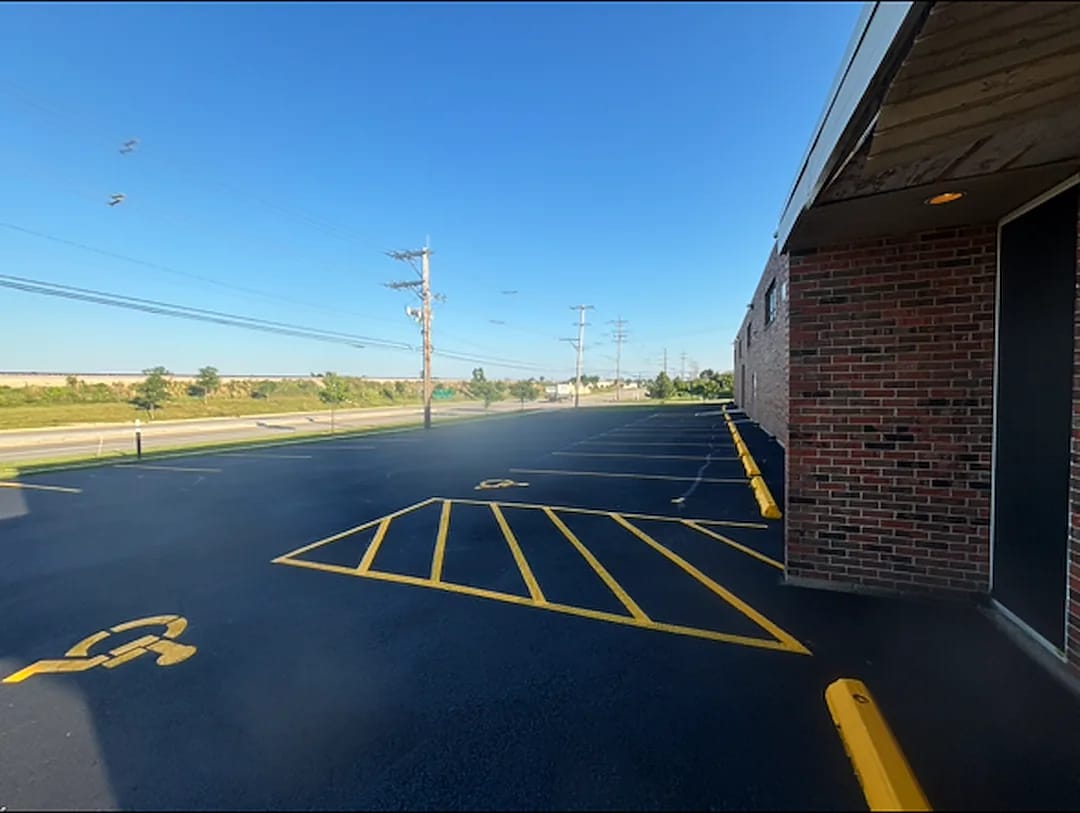
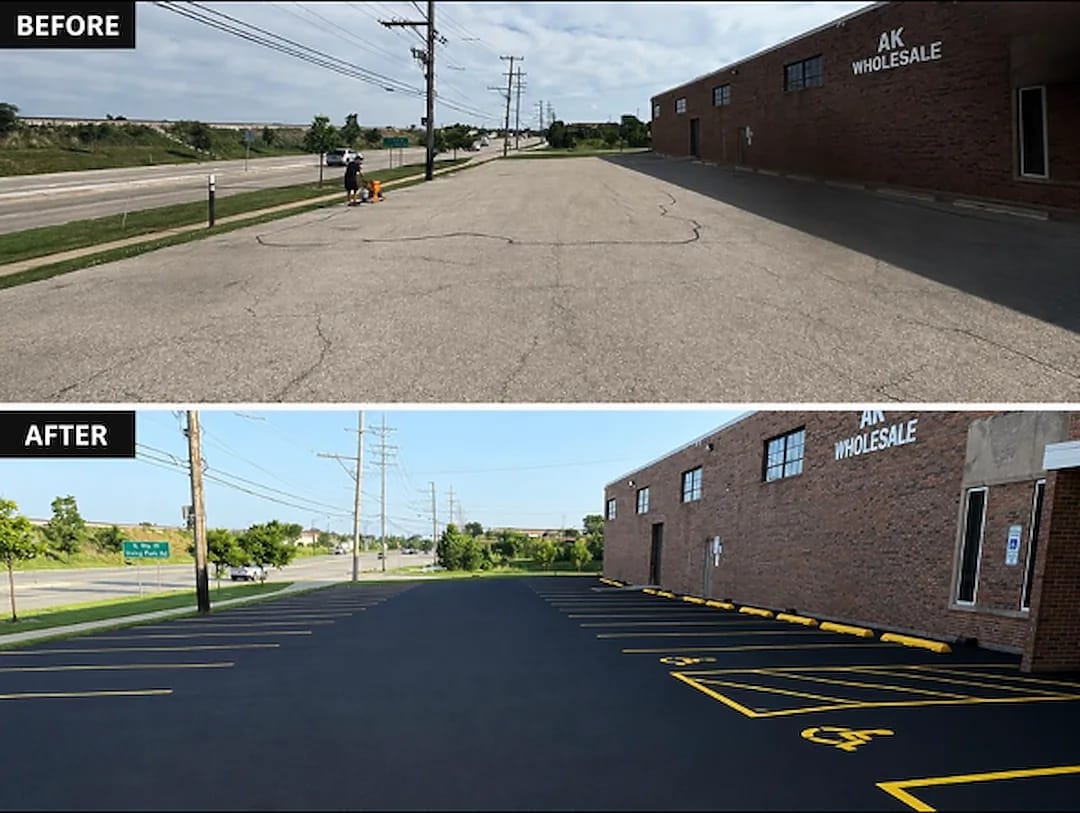
Sealcoating protects asphalt that is still structurally sound. Resurfacing replaces asphalt that has failed. The deciding question is not how bad the lot looks — it is whether the damage is at the surface or in the base underneath. Grey, oxidised asphalt with a few isolated cracks is a sealcoat job. Interconnected cracking, areas that feel soft underfoot, and potholes that keep coming back in the same spot are base failure, and no coating fixes that.
Getting this wrong is expensive in both directions. Sealcoating a failed lot buys you one season and wastes the money. Resurfacing a lot that only needed a crack seal and a coat wastes considerably more.
What sealcoating actually does
Sealcoat is a thin protective layer — asphalt emulsion or coal-tar — applied over the existing surface. It does three things: shields the asphalt binder from UV oxidation, keeps water and fuel from soaking into the surface, and restores the black finish that makes fresh striping look sharp.
What it does not do is add strength. It is measured in fractions of an inch and it carries no structural load. Think of it as paint on timber: it protects sound material from weathering, and it does nothing whatsoever for rot.
Crack sealing is the step people skip, and it is the one that matters most. Hot rubberised filler goes into working cracks before any coating. Sealcoat applied over an unsealed crack is a wasted coat — the crack keeps moving with temperature and reopens straight through it, usually within a season.
What resurfacing actually does
Resurfacing (an overlay) mills off or covers the existing surface and lays new asphalt over the base. It is a structural repair: it restores thickness, it can correct drainage and surface profile, and it gives you a genuinely new surface.
It costs several times what sealcoating costs, takes longer, and puts more of your lot out of use while it happens. It is the right answer when the surface has failed — and the wrong answer when it has merely aged.
Between the two sits full-depth patching: cutting out and replacing failed sections while leaving the sound majority of the lot alone. On most lots we look at, the honest recommendation is patching the bad areas and sealcoating the rest, not resurfacing everything.
How to read the damage
Walk the lot and look at what kind of cracking you have. The pattern tells you where the problem is.
Surface oxidation — sealcoat
The asphalt has gone from black to grey, and the surface feels rough with loose aggregate coming away when you brush it. This is UV damage to the binder. It is exactly what sealcoat exists to prevent, and a lot in this condition is a good candidate.
Isolated linear cracks — crack seal, then sealcoat
Single cracks running in lines, often along the joints where paving passes met, or transversely across the lot. As long as they are isolated and the pavement either side is solid, these are sealed and coated over. Do it before they widen.
Alligator cracking — structural
Interconnected cracks in a pattern like reptile skin, usually in wheel paths or near entrances. This means the base has lost its load-bearing capacity and the surface is flexing over it. Sealcoat over alligator cracking is cosmetic and will telegraph through within months. These areas need cutting out and rebuilding.
Potholes — patch first, always
A pothole is a hole all the way through the surface. It gets cut out square, the base is compacted, and it is filled with hot mix. What matters is whether they recur. One pothole is damage; the same pothole three winters running means water is still getting into the base nearby.
Soft or spongy areas — structural
Walk the lot after rain. Anywhere that feels like it gives underfoot, or where a vehicle leaves visible depressions, has a base or drainage problem. Coating over this achieves nothing.
Standing water — a drainage problem, not a surface one
Puddles that persist more than a day after rain mean the surface does not drain. Sealcoat will not change the profile. This needs the grade corrected, which is a resurfacing or a targeted reconstruction question.
Comparing the options
Costs vary too much by lot size, access and local conditions for a national figure to mean anything — get a measured quote rather than trusting a per-square-foot number off the internet. What is useful is the relative scale and lifespan.
| | Crack seal + sealcoat | Patch + sealcoat | Resurfacing (overlay) | | --- | --- | --- | --- | | Fixes | Surface oxidation, isolated cracks | The above, plus localised failure | Structural failure, drainage, profile | | Relative cost | Lowest | Low to moderate | Highest — several times a sealcoat | | Typical service life | 2–4 years before recoating | 2–4 years before recoating | 10+ years with maintenance | | Lot downtime | ~24 hours per phased section | 1–2 days | Several days to weeks | | Adds structural strength | No | Only in the patched areas | Yes | | Right when | Base is sound, surface has aged | Most of the lot is sound | Base has failed across the lot |
The pattern worth noticing: sealcoating is not an alternative to resurfacing. It is what you do instead of ever needing resurfacing, if you start early enough and keep to a cycle.
The Chicago factor
Freeze-thaw is what turns a small crack into a structural problem here faster than in milder climates. Water gets into a crack, freezes, expands roughly nine per cent, and levers the crack wider. Then it thaws, more water gets in, and it happens again — dozens of times over a Chicago winter.
That is why crack sealing in the autumn is the single highest-value maintenance you can buy on a lot in this region. A crack sealed in October is a crack that does not spend the winter being jacked open. The same crack left alone can be a patch job by April.
It also constrains the calendar. Sealcoat needs surface temperatures reliably above roughly 50°F and a dry 24 hours, so the practical window here is late spring through early autumn. Crack sealing has a wider window and is worth doing in the autumn even when the coating waits until spring.
When a contractor should talk you out of it
A few things worth knowing, because they are how you tell a straight quote from a sales pitch.
- Nobody should offer to sealcoat over potholes. If a quote covers a lot with visible potholes and does not itemise patching first, that is a coating being sold over a problem.
- Sealcoating every year is too often. Every two to four years suits most commercial lots. Annual coating is money spent on build-up you do not need.
- A lot with widespread alligator cracking should not be quoted as a sealcoat. If it is, ask directly what happens to that cracking after the coat goes down.
- "Resurface the whole lot" deserves a second opinion when only part of it has failed. Patching the bad areas is usually the honest answer.
What this means for your property
Walk your lot and sort the damage into two piles: surface, and structural. If it is nearly all surface, you want crack sealing, a sealcoat and a restripe, and you want it on a two-to-four-year cycle from now on. If there is real structural failure, get the failed areas patched and coat the rest — and start budgeting for an overlay on a realistic timeline rather than an emergency one.
If you are not sure which pile something belongs in, that is exactly what a site visit is for. We will tell you when a lot needs less than you expected — see what is involved in pavement repair and sealcoating, or read what faded markings really cost you if you are building a case for the budget. Call (773) 858-1077.