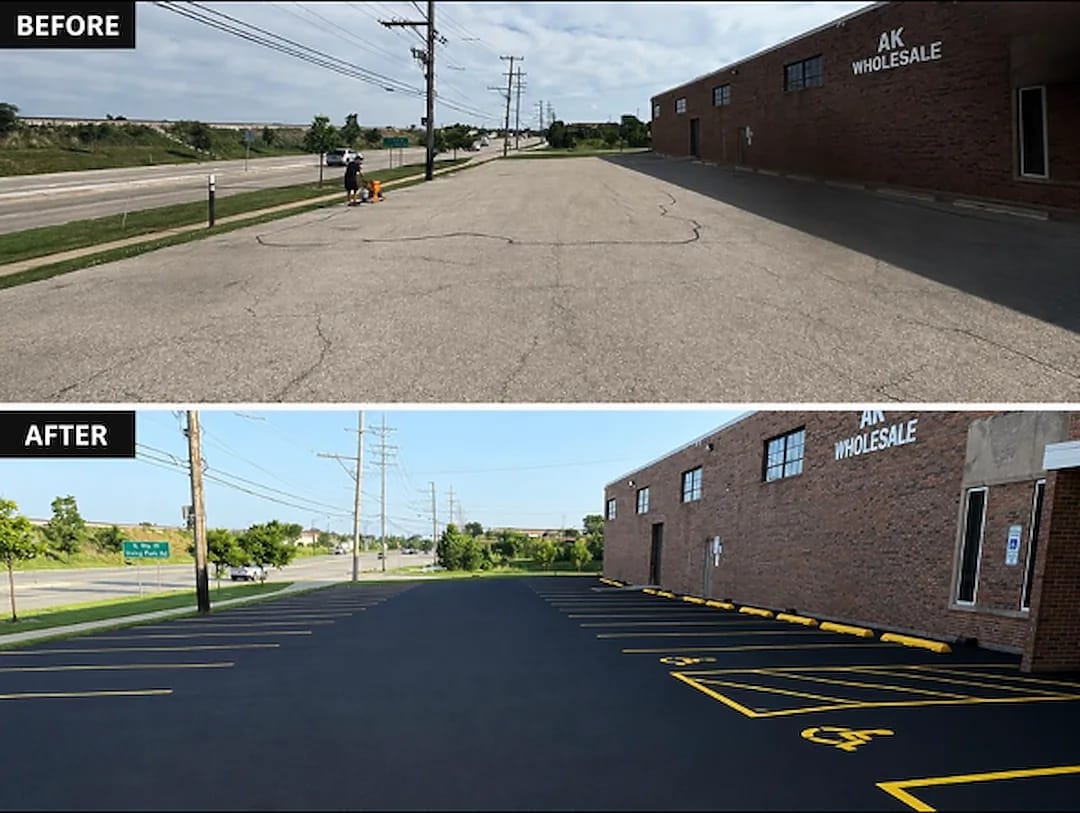
Most commercial parking lots in the Chicago area need restriping every 18 months to 3 years. High-turnover retail and drive-thru sites sit at the short end; a low-traffic office lot that is ploughed gently can stretch past three years. The interval is driven by four things: how many vehicles cross the lines, how aggressively the lot is ploughed and salted, how much direct sun the surface takes, and what the lines were painted with in the first place. If drivers are guessing where the stalls are, you are already past due.
That is the short answer. The rest of this explains how to work out your number rather than a generic one, because "every two years" applied to the wrong lot is either wasted money or a liability sitting in your car park.
Why Chicago lots fade faster than the national averages
Most restriping advice you will read is written for a national audience, and it quietly assumes a milder climate. Chicagoland is harder on pavement markings than average for three specific reasons.
Ploughing. A steel plough blade riding across a lot does not care about your stall lines. Every pass scrapes a little paint off the high points of the asphalt, and the lines running perpendicular to the plough direction take the worst of it. A lot that is ploughed fifteen times a winter can lose more line in one season than it loses in two summers of traffic.
Road salt and de-icer. Salt is abrasive as it is dragged across the surface under tyres, and the freeze-thaw churn it enables works at the bond between paint and asphalt. Lines near entrances, where the most salt gets tracked in, almost always fail first.
A compressed working season. Traffic paint needs a dry surface and reliable temperatures, which in practice means roughly April through October here. That matters for planning: if your lot becomes unreadable in January, you are not fixing it in January. You are living with it until spring, and booking early because everyone else has the same problem in the same eight-week window.
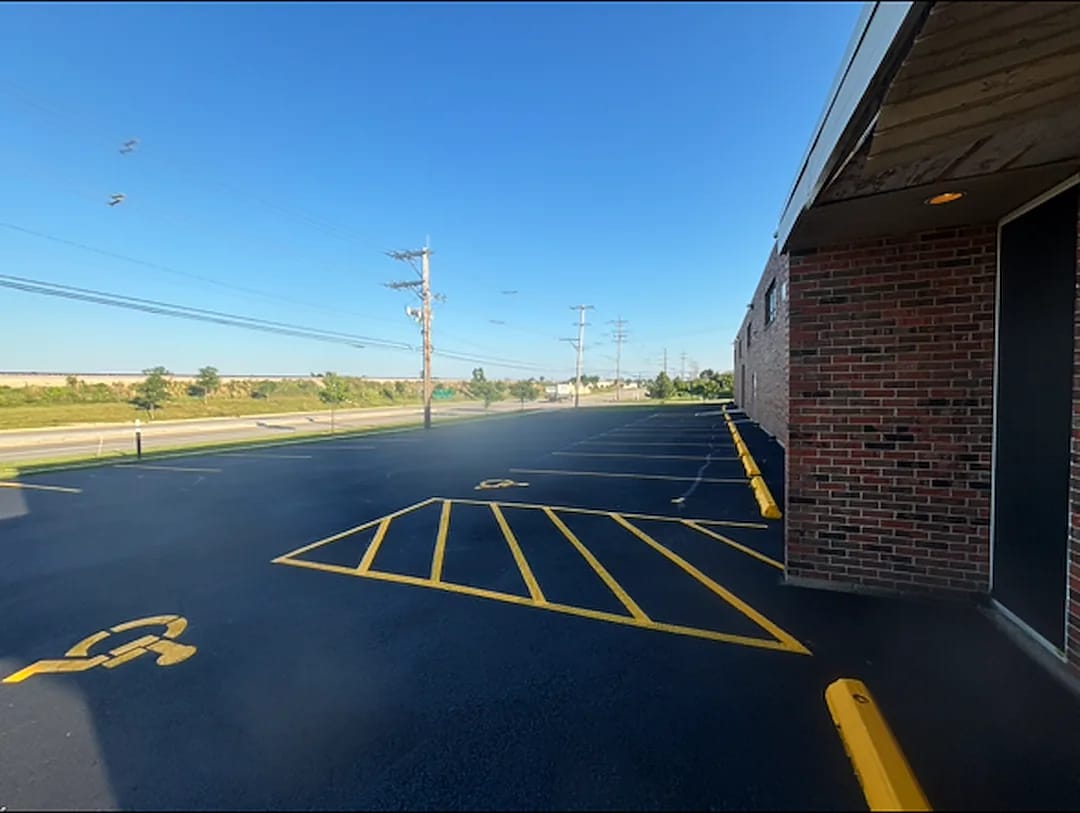
The four factors that set your interval
Traffic volume and turnover
Turnover matters more than headcount. A hundred cars that arrive at 8am and leave at 6pm cross the lines twice. A hundred cars cycling through a coffee shop lot in a morning cross them constantly, and they turn while doing it — which is what actually scrubs paint off. Retail plazas, medical offices, fast food and anywhere with a drive-thru wear markings two to three times faster than an office or industrial lot with the same stall count.
Snow removal method
Ask your snow contractor what they use. A steel-edged plough is hardest on markings; a rubber or polyurethane cutting edge is significantly gentler and worth requesting if your lot has recently been striped. Where a lot is ploughed by a skid-steer that pivots in place, expect concentrated wear at the turning points.
Sun exposure
Ultraviolet light breaks down the binder in traffic paint. South- and west-facing rows with no shade fade visibly sooner than rows under mature trees or in a building's shadow — which is why a lot often looks patchy rather than uniformly worn. If half your lot looks fine and half looks tired, this is usually why.
What the lines were painted with
Water-based traffic paint is the standard for parking lots and the right choice for most of the surface: it cures fast enough to reopen sections the same day and is straightforward to refresh. Thermoplastic is heat-applied, far thicker, and lasts several times longer — which is why we specify it at entrances, in drive aisles and anywhere tyres scrub the same line daily, rather than across a whole lot where it would be an expensive way to mark a stall nobody turns in.
Recommended intervals by property type
Treat these as a planning baseline, then adjust up or down using the four factors above. A retail plaza with a rubber-edged plough and heavy tree cover might make three years; an office lot ploughed hard with steel might not make two.
| Property type | Typical interval | What pushes it shorter | | --- | --- | --- | | Fast food / drive-thru | 12–18 months | Constant turning traffic on the same lines | | Retail plaza | 18–24 months | High turnover, heavy winter ploughing | | Medical / healthcare | 18–24 months | Accessible stalls get heavy use and scrutiny | | Multi-family / HOA | 2–3 years | Numbered stalls must stay legible to avoid disputes | | Office | 2–3 years | Low turnover, but full winter plough exposure | | Industrial / warehouse yard | 2–3 years | Heavy axle loads, but fewer passenger movements | | Parking garage (covered) | 3–5 years | No UV or plough damage; wear concentrates on ramps |
Covered garages are the outlier. With no sun and no ploughing, open bays hold their marking for years — but ramps, turns and entrance aprons take constant tyre scrub and wear far faster than the rest of the deck. That is a good argument for a harder-wearing material in those areas specifically, which is part of how we approach parking garage and deck marking.
Five signs your lot is already overdue
You do not need a schedule to know when markings have failed. Walk the lot and look for these.
- Drivers are parking wide or crooked. This is the earliest commercial symptom, and it costs you spaces before it looks bad. If a lot laid out for sixty cars is holding fifty, faded lines are usually why.
- You can see the line better when it is wet than when it is dry. Water fills the texture of the asphalt and briefly restores contrast. If that is the only time the layout reads clearly, the paint is nearly gone.
- The ADA symbol has worn to an outline. Accessible stall markings get the most foot traffic of anything you have painted, and they are the first thing anyone photographs in a complaint.
- Fire lane markings are patchy. This one is not about appearance. It is the thing a fire marshal checks, and "it used to be marked" is not a defence.
- You have stopped noticing. Fading is gradual enough that people who see the lot daily stop registering it. Compare a photo from two years ago, or ask somebody who has not been on site recently.
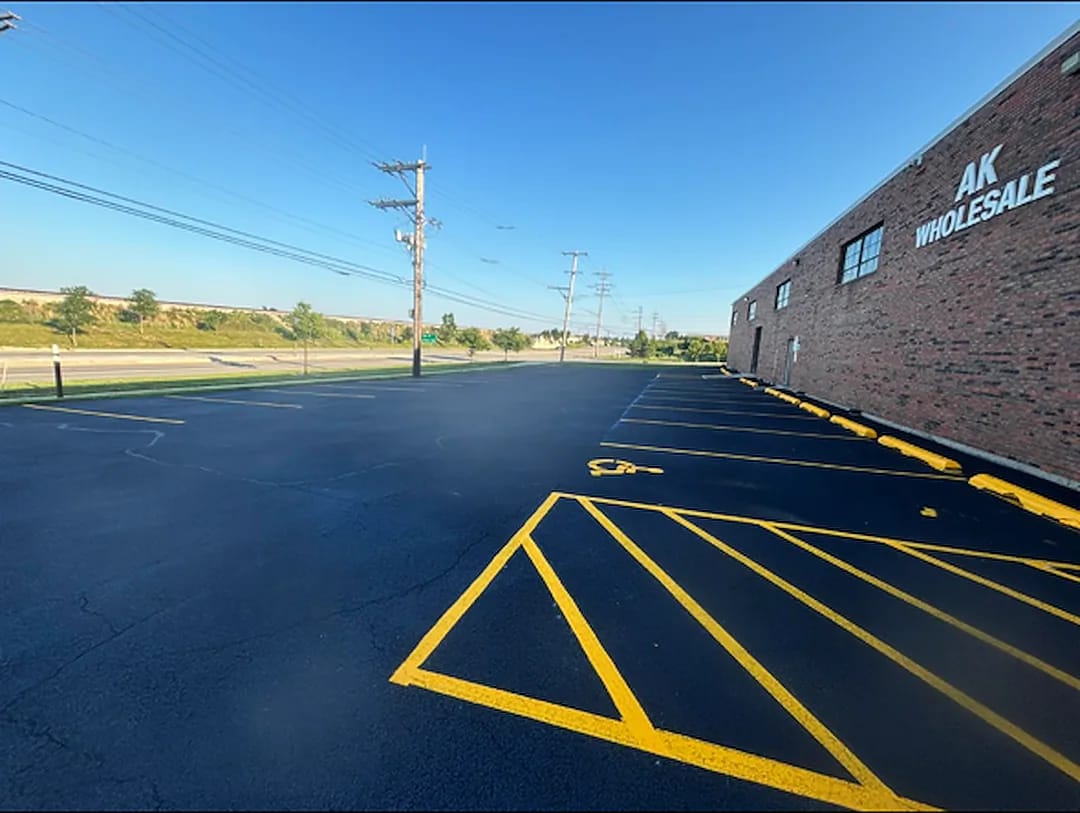
Restriping alone, or sealcoat first?
If the asphalt underneath is sound and just looks grey and tired, sealcoating before you restripe is usually worth it. You get a uniform black surface, the new lines have maximum contrast against it, and the coating protects the surface from the oxidation that made it grey in the first place. Doing both together also means one mobilisation instead of two.
If the surface is cracked, the order matters: crack sealing comes first, then sealcoat, then striping. Coating over an unsealed working crack is a wasted coat — the crack keeps moving and reopens through it within a season. We cover how to tell which of these your lot needs in sealcoating vs. resurfacing.
And if the base has genuinely failed — interconnected "alligator" cracking, spongy areas underfoot, potholes that return in the same place — no amount of paint or coating fixes that, and anyone telling you otherwise is selling you a few months.
What this means for your property
Put restriping on a maintenance cycle rather than waiting for a complaint. For most Chicago commercial properties that means budgeting for it every two years, inspecting each spring, and booking early — the striping season here is short and the good windows in April and May go quickly.
Three practical steps:
- Photograph your lot each spring from the same two or three positions. Year-on-year comparison catches gradual fade that daily familiarity hides.
- Ask your snow contractor about their cutting edge. A rubber edge on a freshly striped lot can add a season to your interval at no cost to you.
- Get the layout reviewed, not just repainted. Re-angling stalls or tightening aisle widths within code can add usable spaces. If you are paying to mark the lot anyway, it is worth knowing whether the current layout is the best one.
If you are not sure where your lot sits, we will come out, measure it and tell you — including if the honest answer is that it can wait another year. Have a look at what is involved in parking lot striping and layout, or call us on (773) 858-1077 and describe the property.