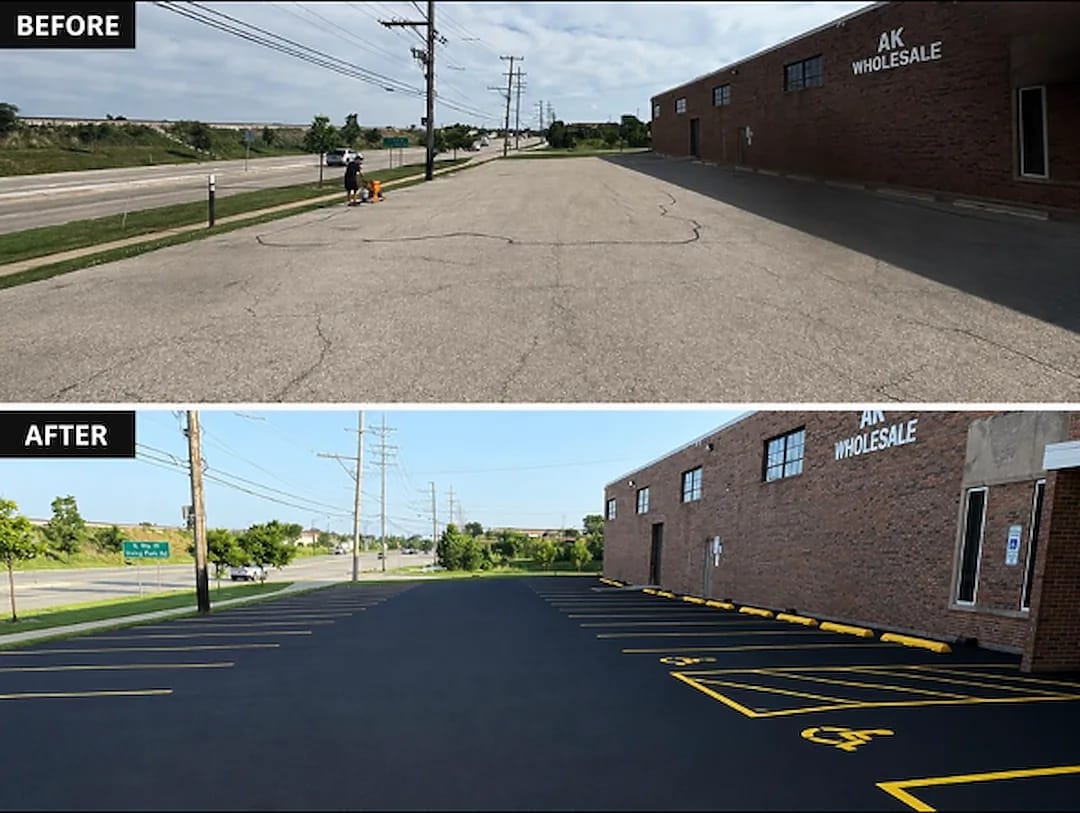
Faded parking lot markings cost you in four measurable ways: lost usable spaces, increased liability exposure, ADA complaint risk, and the perception problem that follows every tenant tour and customer visit. Restriping is among the cheapest maintenance line items on a commercial property — usually a one-day job — and it is routinely deferred because nothing appears to be broken. That deferral has a price. This is how to put a number on it.
You are losing spaces right now
This is the cost nobody counts, and it is usually the largest.
When drivers cannot see where a stall begins and ends, they centre themselves on the space they can see and park wide. On a lot with faded lines, the drift is consistent and it compounds down a row. A lot laid out for sixty cars commonly holds fifty-something once the lines go.
Work out what that is worth on your property. If you charge for parking, it is direct revenue: ten spaces at whatever your monthly rate is, times twelve. If you do not charge, it is still real — it is the overflow that pushes customers to a competitor with easier parking, or the tenant complaint that your building "does not have enough parking" when in fact it does, and you cannot see it because the lines are gone.
There is a second version of this. If your lot has never had a proper layout review, the stall count you have may not be the stall count the asphalt can support. Re-angling stalls or tightening aisle widths within code can add usable spaces without touching the pavement. If you are paying to mark the lot anyway, it is worth knowing whether the current layout is the best one available.
Liability is the expensive tail
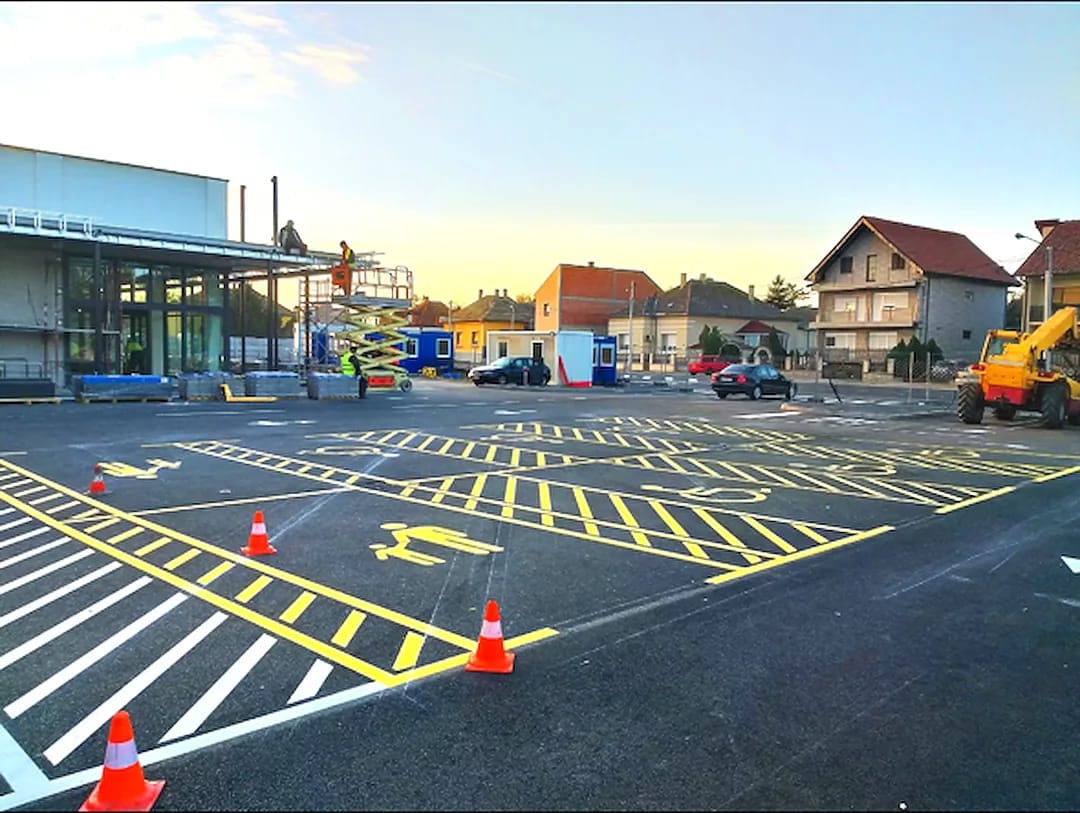
Pavement markings do a job beyond telling drivers where to park. They separate vehicles from pedestrians, they identify hazards, and they establish where people are supposed to walk.
When those markings are gone, three things change for you.
Pedestrian routes stop existing. If the crosswalk between the lot and the entrance has faded, people cross wherever. When somebody is struck in a car park, one of the first questions is what the site did to separate pedestrians from vehicles.
Hazards stop being marked. Yellow kerb paint, bollard marking and hatched no-parking zones exist because something there is a hazard. Faded kerb paint at a change in level is a trip hazard that used to be marked and now is not — and "used to be marked" is a difficult position to defend, because it demonstrates the hazard was known.
Your maintenance record becomes the evidence. In a premises liability claim, what matters is whether the owner knew or should have known about a hazard and what they did. A documented restriping cycle is a good answer. A lot last marked at an unknown date is not.
None of this means faded lines cause claims. It means that when a claim happens for unrelated reasons, faded markings make it materially harder and more expensive to defend.
ADA exposure is the one with the lowest threshold
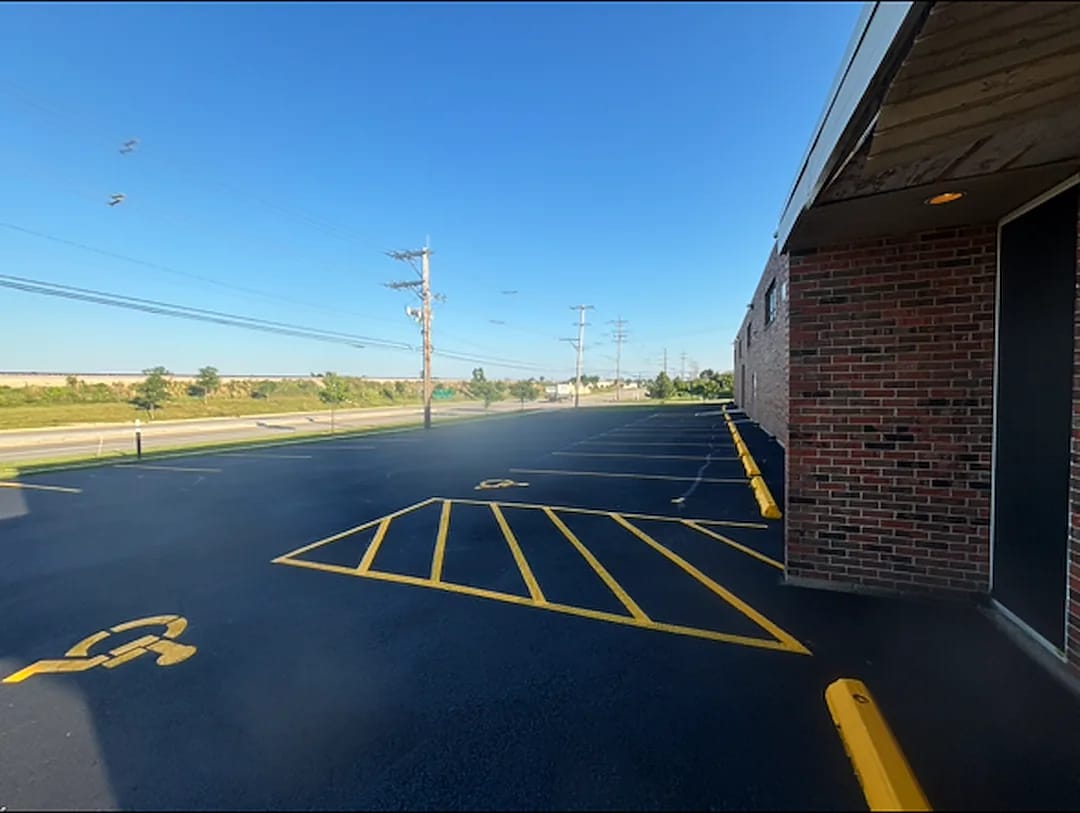
Accessible parking is the most commonly cited deficiency on commercial lots, and it needs no incident to trigger. Someone photographs a worn accessible symbol or a missing access aisle from the public footpath, and you have a complaint.
Accessible stall markings also fade fastest. They are large areas of paint, in the spaces closest to the entrance, taking the most foot traffic on the lot. The symbol is usually the first marking to go.
The cost asymmetry here is stark. Remarking an accessible symbol and re-hatching an aisle is a small line item on a restriping job. Responding to a complaint costs vastly more even when you are ultimately fine — and if the lot genuinely is short of spaces or missing an access route, you are into remedial work you would have paid far less for on your own schedule. Our ADA compliance checklist for Illinois properties walks through what to look for.
Perception costs you tenants
This one resists measurement, which is why it gets ignored.
The car park is the first thing anyone sees. Before the lobby, before the signage, before anything you have spent money on inside. A faded, patchy lot with cars parked at odd angles reads as deferred maintenance, and people reasonably assume that what they can see is representative of what they cannot.
For a prospective tenant on a tour, that impression is set before they reach the door. For a retail customer, an unclear lot is friction at exactly the moment they are deciding whether the trip was worth it. For a property being marketed or valued, kerb appeal is part of the number.
You do not need a study to sanity-check this. Look at your lot from the entrance the way somebody seeing it for the first time would.
Deferred maintenance economics
Here is the part that makes the case to a budget holder. Markings are the cheapest layer of a pavement system, and they are the layer that protects the expensive ones from being ignored.
A restripe is a single day and a modest cost. A sealcoat is a modest multiple of that. An overlay is several times a sealcoat. A full reconstruction is several times an overlay. Each layer buys time on the one below.
The trap is that faded markings make the whole lot look uniformly tired, which makes the surface condition harder to assess — so surface problems get noticed later, when they are structural rather than cosmetic. A lot on a marking cycle gets looked at regularly by someone who knows what cracking means. A lot nobody has touched in five years gets looked at when something fails.
| Deferred item | What it costs later | | --- | --- | | Restriping | Lost usable spaces, weaker liability position, ADA exposure | | Crack sealing | Water into the base, then patching or an overlay | | Sealcoating | Accelerated oxidation, shorter surface life | | Patching | Failure spreads outward from the unrepaired area |
The sequence matters because each row enables the next. See sealcoating vs. resurfacing for how to tell which of these your lot is actually facing.
What a restripe actually costs you in disruption
Owners often defer striping because they assume the lot has to close. It does not.
Water-based traffic paint is dry to walk on within about thirty minutes and ready for traffic in roughly an hour in warm, dry weather. We phase the work section by section, so most of the lot stays open throughout. On a typical retail plaza nobody loses a full day of parking, and overnight and weekend work is standard for sites that cannot give up spaces during business hours.
The real scheduling constraint in Chicago is seasonal, not operational. Traffic paint needs a dry surface and reliable temperatures, which means roughly April through October here. The good windows in spring book out quickly, so the practical cost of deferring is often not money — it is waiting until next season.
What this means for your property
Treat markings as a scheduled maintenance item with a defined interval, not as a repair you make when somebody complains.
Three things worth doing:
- Photograph the lot each spring from the same two or three positions. Year-on-year comparison catches gradual fade that daily familiarity hides completely.
- Count your actual usable spaces against the number your layout is supposed to provide. If they differ, that gap has a value you can put in a budget request.
- Put restriping on a cycle — every two years suits most Chicago commercial lots — and get the accessible markings inspected annually regardless, because they fade fastest and carry the most risk.
If you want a number for your own property rather than a general argument, we will measure the lot, tell you the usable stall count you have versus the one the layout should give you, and quote the work itemised. It costs nothing. See parking lot striping and layout or call (773) 858-1077.